
The buzz around this product has created strain on supply and led to a sharp increase in price. Argentina is among the producers. The case of Lucciano’s, Havanna, and the oil company.
Buenos Aires — The viral spread of “Dubai chocolate” on social media sparked a pistachio craze in Argentina. The consumption boom pushed up the price of this green nut, which is a global sensation, but also reignited concerns about supply, even though in recent years the areas where it is cultivated in the country have grown exponentially, increasing fivefold.
In recent weeks, two of the country’s leading ice cream and chocolate brands launched products featuring their own version of the so-called “green gold” and recorded record sales, further accelerating demand.
But these companies—and others that use pistachios as an input—are now facing limited supply and tensions in the supply chain. This is happening despite the fact that Argentina produces pistachios and that, in the past five years, local production—concentrated in the province of San Juan due to climatic factors—has increased cultivated hectares by more than 500%.
• Everything is rising: According to Bloomberg data, the price increased by 17% in one year to US$23 per kilogram.
• Leaders: The United States (California), Iran, and Turkey are the main producers. 71% of the pistachios exported worldwide come from the United States.
• Climate factor: Pistachio cultivation requires “arid environments with cold winters and very hot summer periods.” The main growing regions worldwide are in the Middle East, the United States, Spain, Italy, Greece, Australia, and Argentina.
Lucciano’s, Havanna, and even an oil company
“We were proactive and stocked up almost a year in advance, with a significant financial effort. If you don’t buy at the beginning of the year during harvest season, you can’t get large quantities and the price goes up,” Christian Otero, founder of Lucciano’s—the ice cream brand competing with Havanna after the nearly simultaneous launch of the Dubai alfajor—told Bloomberg Línea.
Otero explains that more than 30% of the flavors sold at Lucciano’s contain pistachio. More than half of the product is sourced in Argentina: 100,000 kilos locally and 80,000 from abroad. He also believes they could exceed 200,000 kilos this year and added: “Historically, the price per kilo ranged between US$18 and US$22; today it can reach as much as US$40.”

“We started by importing finished paste from Italy, then we discovered pistachios from San Juan,” Otero said. “I don’t think it’s a trend; it’s a product that has been well established in Europe for many years. In our case, it’s here to stay and will have a significant presence in products in Argentina,” he added.
At Havanna (HAVA), pistachio supply is key. Since the launch of the Dubai alfajor on July 11, they have sold 320,000 alfajores. According to the company, with the pistachios they were able to source, they produced as many alfajores as possible and sold them all, until reaching a stock shortage. “We produce, we sell, they sell out; as we receive more pistachios, we will produce more alfajores,” a Havanna spokesperson explained.

At the beginning of the year, the oil company YPF surprised the market by launching a pistachio alfajor for its YPF FULL stores at service stations. According to the company, “since its launch in January, the Alfajor Full Pistachio has been a real success in the market, with 640,000 units sold in six months, reflecting excellent consumer reception.”
San Juan, the pistachio province
“According to the latest National Agricultural Census (2018), San Juan is the main producing province at the national level, with 6,500 hectares, representing approximately 90% of the cultivated area in Argentina,” states a report by the National Institute of Agricultural Technology (INTA), which, together with CONICET, developed an agro-environmental zoning map to support the sector’s growth.
Following San Juan are Mendoza (around 770 cultivated hectares), La Rioja (100 hectares), and La Pampa (55 hectares). Pistachio exports, considered a regional economy, are not subject to export duties.
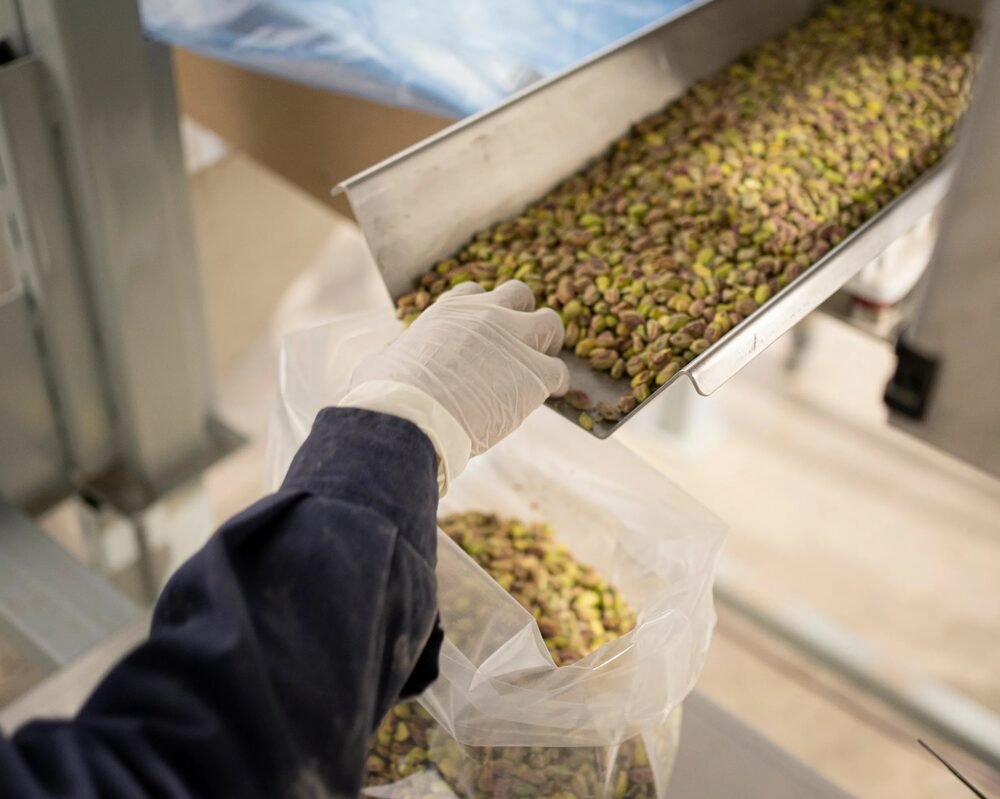
San Juan–based Pistacho de los Andes is one of the country’s main producers. Its director, Marcelo Nemirovsky, told Bloomberg Línea that the company was founded in 1998 with the planting of the first 75 hectares. Today that number has grown to 300, of which 90 are in production, with another 50 expected to come online in the short term.
“It takes between five and six years to begin production, and between 10 and 12 years to reach full production levels, which can last for up to 50 years,” explained Nemirovsky, who believes the business “is here to stay.” “It’s a good long-term investment; it’s not for those expecting quick returns. The barrier to entry is not low, and there are not many places where it can be produced,” he added.
“It’s a good long-term investment; it’s not for those expecting quick returns. The barrier to entry is not low, and there are not many places where it can be produced.”
Marcelo Nemirovsky, Pistacho de los Andes
According to the entrepreneur, due to the price of pistachios—which are sold shelled or unshelled (kern), as well as roasted and salted—the business is profitable, although costs have “risen significantly.”
“Demand has increased everywhere. The domestic market is demanding much more than last year. Beyond trends, it is a highly sought-after nut due to its properties, and in South America it is only produced in Argentina,” he said.